
Michigan Senate Race 2026 Shows a Major Divide Between Polls and Prediction Markets
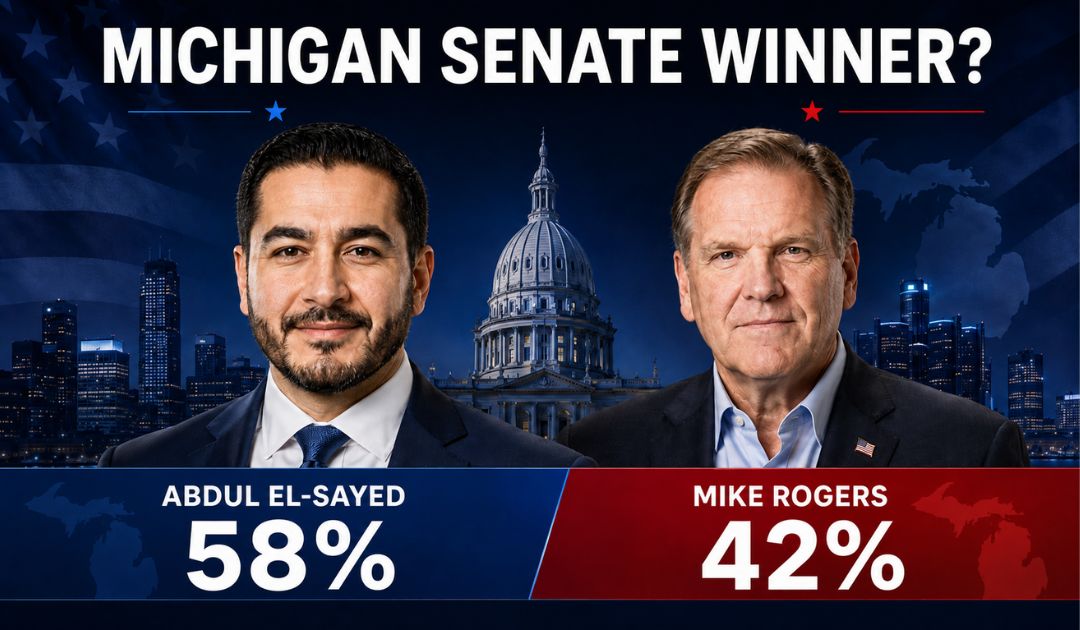
The 2026 Michigan Senate race is showing one of the most interesting gaps between prediction-market prices and recent polling. Kalshi currently gives Democrat Abdul El-Sayed a 58% probability of winning, while Republican Mike Rogers sits at 42%, even as several recent polls show Rogers leading or tied.
Michigan voters will decide one of the country's most important U.S. Senate elections on November 3, 2026. Democrat Abdul El-Sayed and Republican Mike Rogers are competing for the open seat being vacated by retiring Democratic Sen. Gary Peters, and control of the Senate could make Michigan especially important on election night.
There is also an unusual disagreement between the prediction market and recent polling. The Kalshi market data captured on August 18 gives El-Sayed a 58% probability and Rogers a 42% probability. Recent polling has moved in the other direction, with the latest Fox News survey showing Rogers ahead 51% to 47%.
This difference is a good example of why Prediction Markets should not be treated as polls. Market percentages reflect prices created by traders trying to predict the final result. Polls measure voter preferences among the people surveyed at a specific point in time.
Michigan Senate Market Snapshot
Kalshi percentages can change throughout the day as contracts are bought and sold. Figures shown here reflect the market information supplied on August 18, 2026. Prediction-market probabilities are not polling results or election results.
Predict the Michigan Senate Winner on Kalshi
Eligible new traders can get a free $10 plus unlock up to $500 in additional bonuses after trading at least $25 through the current Kalshi offer.
Get Free $10 + Up to $500Recent Michigan Senate Polls Favor Mike Rogers
The latest polling presents a different picture from the current Kalshi market. A Fox News poll conducted August 6 through August 10 among 1,006 registered Michigan voters shows Rogers at 51% and El-Sayed at 47%. The four-percentage-point difference is within the poll's ±3-point margin of sampling error.
The Fox poll is not an isolated result. The five recent polls supplied for this article show Rogers ahead in four surveys, with one poll tied.
| Poll | Result | Current Direction |
|---|---|---|
| Fox News | Rogers 51%, El-Sayed 47% | Rogers by 4 percentage points |
| EPIC-MRA | Recent Michigan survey | Rogers by 3 percentage points |
| SoCal Strategies | Recent Michigan survey | Rogers by 1 percentage point |
| Mitchell Research | Recent Michigan survey | Tied |
| Glengariff Group | Recent Michigan survey | Rogers by 10 percentage points |
Polls measure voter preferences, while Kalshi measures market probabilities. Different methodologies, voter samples, timing, and assumptions can produce different pictures of the race.
What the Fox News Poll Shows Beyond the Topline
Rogers has greater party unity in the Fox survey. The poll reports that 96% of Republicans support him, including 99% of MAGA Republicans and 89% of non-MAGA Republicans.
El-Sayed receives support from 91% of Democrats and 98% of Democratic Socialists of America supporters, but support falls to 69% among the poll's combined group of non-DSA Democrats and independents.
The poll also finds greater Democratic enthusiasm. Democrats are more likely than Republicans to say they are extremely interested in the election, extremely motivated to vote, and certain they will cast a ballot. Among voters the survey classifies as definite voters, El-Sayed actually holds a four-percentage-point advantage.
Why Michigan Could Decide Control of the U.S. Senate
Michigan is not simply another competitive Senate race. The Washington Post reports that the Democratic path to a Senate majority depends heavily on defending Michigan while also flipping several Republican-held seats elsewhere.
Democrats currently need to protect their existing seats and flip four Republican seats to take control. According to The Washington Post, losing Michigan would force Democrats to find an additional Republican seat to win in territory that is considerably more difficult for the party.
Republicans also have history working against them. Michigan has not elected a Republican U.S. senator in more than three decades. Rogers came extremely close in 2024, losing the state's other Senate race to Democrat Elissa Slotkin by roughly 19,000 votes.
Michigan also remains politically competitive at the presidential level. Donald Trump carried the state in both 2016 and 2024 by less than 2 percentage points, while Joe Biden won it in 2020 by nearly 3 points.
Abdul El-Sayed and Mike Rogers
Abdul El-Sayed
Democratic Party · 58% Market ProbabilityEl-Sayed won a difficult Democratic primary against Rep. Haley Stevens and enters the general election with support from much of the Democratic coalition. His progressive politics also create one of the central questions of the race: whether the coalition that delivered his primary victory can expand enough to win a statewide general election.
Mike Rogers
Republican Party · 42% Market ProbabilityRogers is a former U.S. congressman making another run for the Senate after narrowly losing in 2024. Recent polling shows him competitive or ahead, and the Fox News poll indicates that Republican voters are currently more unified behind him than Democrats and independents are behind El-Sayed.
El-Sayed Faces a Difficult Coalition Test
One of El-Sayed's immediate challenges is bringing together Democrats who backed different candidates in the primary. The Washington Post reports that Senate Minority Leader Chuck Schumer backed Haley Stevens because he believed she had a better chance of winning the general election. Schumer endorsed El-Sayed after the primary, but political differences remain.
Israel policy is one of the most visible disagreements. The Washington Post reports that some Jewish Democrats in Michigan remain uncomfortable with El-Sayed's rhetoric toward Israel, while other Jewish voters support him or remain open to doing so. In a close statewide election, even relatively small movements among Democratic constituencies could matter.
Fox News also reports that Stevens, despite endorsing El-Sayed after losing the primary, publicly urged him to end his affiliation with controversial political streamer Hasan Piker. El-Sayed appeared with Piker during the primary, and that relationship has become part of the Republican argument that El-Sayed is outside Michigan's political mainstream.
El-Sayed has rejected the idea that his policy agenda is radical and continues to argue that his campaign is focused on healthcare, economic affordability, and government accountability.
Rogers Has Vulnerabilities of His Own
The current polling advantage does not make Rogers an automatic favorite. The same Fox News poll showing him ahead finds that 51% of Michigan voters are concerned that Rogers is too closely aligned with President Trump.
Among independents, concern about Rogers' relationship with Trump is greater than concern about El-Sayed's issue positions. The poll also shows Democratic voters reporting higher levels of interest and motivation ahead of the November election.
That creates a turnout question. Rogers can lead among registered voters while still facing a difficult election if Democratic voters participate at higher rates. El-Sayed's four-point lead among voters who tell Fox they are definite to vote is one reason the general election cannot be reduced to the 51% to 47% headline alone.
The Democratic Party Has Its Own Favorability Problem
NBC News has also highlighted a broader warning sign for Democrats heading into the 2026 midterms. The national favorability data shown in the NBC segment supplied for this article places the Democratic Party roughly 25 points underwater in 2026, compared with an even net favorability measure in 2018.
National party favorability does not determine a Michigan Senate election by itself. Candidate quality, turnout, economic concerns, presidential approval, local issues, and the state's political geography can all produce different results. Still, the national environment adds another variable to a race where Democrats are trying to defend a seat in a state Trump won two years ago.
My Take as a Michigan Native
This section reflects Robert Beadle's personal opinion and is separate from the polling and prediction-market data above.
As a Michigan native, born and raised, this is one of the most important midterm Senate elections that I can remember in my 46 years. I don't think I'm alone in seeing this race as unusually consequential for Michigan and for control of the Senate.
My personal view is that the current 58% Kalshi probability on El-Sayed looks too optimistic. That does not mean I think El-Sayed is a bad person, and it is not simply because I disagree with much of his politics. My concern is whether he can build a broad enough statewide coalition after an already divisive Democratic primary.
The Hasan Piker relationship is one example. Haley Stevens is now supporting El-Sayed against Rogers, but she has still publicly told him that ending that affiliation makes sense. That is significant because Stevens performed well among some of the Democratic constituencies El-Sayed now needs in November.
I also think some of El-Sayed's older comments create unnecessary political distractions. His own description of football is a good example. He has said, "I love football, but I hate having to admit that." He has credited the sport with teaching him important lessons while also criticizing its brutality and culture. That is more nuanced than simply saying he hates football, but politically it creates an easy line of attack in a state where football is a major part of the culture.
The same applies to old comments about Fourth of July fireworks and Mackinac Island that have circulated during the campaign. Voters can decide for themselves how much those statements matter. My concern is that every one of these controversies forces El-Sayed to spend time explaining old comments instead of talking about healthcare, jobs, inflation, and other issues that could help him win swing voters.
Republicans have not won a Michigan U.S. Senate election in more than three decades, so history still favors Democrats. Michigan also has a large Democratic turnout base, and El-Sayed's supporters are highly motivated. That is why I would not treat this race as settled in either direction.
But if I were looking only at the current polling, the political controversies, and the coalition each candidate needs to assemble, I would be much less confident in El-Sayed than the current 58% Kalshi market probability suggests. That is my opinion as a Michigan voter and publisher, not a polling model or an election forecast.
Why Does Kalshi Favor El-Sayed While Polls Favor Rogers?
A prediction market and a public-opinion poll measure different things. Kalshi traders are pricing the probability of the final election result. Pollsters are asking voters who they support at the time of the survey.
Market Traders Can Price Turnout
Traders may believe Democratic enthusiasm, Michigan's recent Senate history, and the national midterm environment will eventually help El-Sayed even if he trails in current registered-voter polling.
Polls Currently Show Rogers Competitive
Recent surveys consistently showing Rogers tied or ahead provide a clear reason to question whether the current 58% market probability accurately reflects the race today.
Michigan Has Split Political Behavior
Michigan voted for Trump in 2024 while simultaneously electing Democrat Elissa Slotkin to the Senate. Presidential voting behavior does not automatically determine a Senate result.
The Campaign Is Still Developing
The Democratic primary ended only recently. El-Sayed and Rogers are now entering the phase where both campaigns will spend heavily defining the other candidate for general-election voters.
Readers who want to understand how these percentages are created can review our Kalshi Prediction Markets page.
What Could Winning the Michigan Senate Market Look Like?
The screenshots supplied for this article show Rogers Yes contracts trading around 43¢ and Rogers No contracts around 58¢. Each contract pays $1 if the selected outcome resolves correctly under Kalshi's contract rules.
Example: Predicting Mike Rogers Wins at 43¢
| Budget | Whole Contracts | Approx. Cost | Payout if Correct | Approx. Profit Before Fees |
|---|---|---|---|---|
| $25 | 58 | $24.94 | $58.00 | $33.06 |
| $50 | 116 | $49.88 | $116.00 | $66.12 |
| $100 | 232 | $99.76 | $232.00 | $132.24 |
This simplified example uses a 43¢ contract price and whole contracts. Actual execution prices, available quantities, and transaction fees can change the final cost and return.
Example: A 58¢ Contract
| Budget | Whole Contracts | Approx. Cost | Payout if Correct | Approx. Profit Before Fees |
|---|---|---|---|---|
| $25 | 43 | $24.94 | $43.00 | $18.06 |
| $50 | 86 | $49.88 | $86.00 | $36.12 |
| $100 | 172 | $99.76 | $172.00 | $72.24 |
Lower-priced contracts provide a larger potential return because the market currently assigns that outcome a lower probability. A contract that resolves incorrectly pays $0.
The 1,000-Contract Examples From the Current Order Book
The supplied Kalshi screenshots also show what a much larger position looks like with estimated fees included.
1,000 Rogers Yes contracts: the displayed estimated cost is $447.16, with a maximum payout of $1,000 and a displayed potential profit of $552.84 if the contracts settle Yes.
1,000 Rogers No contracts: the displayed estimated cost is $597.06, with a maximum payout of $1,000 and a displayed potential profit of $402.94 if the contracts settle No.
Those figures are examples from the order-entry screenshots, not guaranteed future prices. Order-book depth, fees, and market prices can change before an order is submitted or filled.
What Could Change the Michigan Senate Race Before November?
Democratic Turnout
El-Sayed performs better among the most engaged voters in the Fox survey. If Democratic enthusiasm converts into higher turnout, the general-election electorate could look different from the registered-voter topline.
Independent Voters
Michigan statewide elections are frequently close enough that independents can decide the result. Both candidates have weaknesses that could affect those voters.
Party Unity
El-Sayed must consolidate Democrats after a contentious primary. Rogers enters the general election with a more unified Republican base according to the latest Fox survey.
Trump's Role in Michigan
Trump won Michigan in 2024, but the Fox poll shows substantial concern about Rogers being too closely tied to him. That relationship could help or hurt Rogers depending on turnout and voter composition.
Economic Conditions
Inflation ranks as the top issue in the Fox News Michigan poll. Changes in household costs, employment, gasoline prices, and the broader economy could affect voter preferences before November.
Campaign Controversies
Both campaigns will continue trying to define the other candidate. El-Sayed's associations and political positions, and Rogers' relationship with Trump, are already central lines of attack.
Trade the Michigan Senate Market
Eligible new users can use the current Kalshi offer to receive a free $10 plus unlock up to $500 in bonuses after trading at least $25. You can also review our Kalshi Promo Codes page for current promotion details.
View the Kalshi OfferWho Is Favored to Win the Michigan Senate Race Right Now?
The answer depends on which measurement you use. Kalshi currently gives El-Sayed the higher prediction-market probability at 58%, compared with 42% for Rogers.
Recent polling points in the opposite direction. The Fox News survey has Rogers ahead 51% to 47%, and the other recent polls supplied for this article show Rogers leading in three additional surveys with one tied.
Neither measurement guarantees the November result. Michigan remains one of the country's most competitive political states, Democrats have not lost a U.S. Senate election there in more than three decades, Rogers came extremely close in 2024, and both candidates enter the final months of the campaign with clear advantages and vulnerabilities.
The disagreement between the prediction market and the polls is exactly what makes this race worth following. If the polling continues to favor Rogers while Kalshi continues to favor El-Sayed, Michigan could remain one of the most debated Senate markets all the way to Election Day.
Sources
Robert Beadle
Robert Beadle leads Bonus Predictions editorial direction, content strategy, research structure, and digital publishing. His work covers prediction markets, event contracts, government developments, bonuses, and the factors influencing live market prices.
Bonus Predictions may receive compensation when readers create an account through an affiliate or referral link. Compensation does not change the market data, polling information, or source reporting presented in this article. Prediction-market percentages are not polling results and can change at any time. Polls are snapshots of surveyed voters and are not election results. Author-opinion sections represent the named author's personal viewpoint. This article provides general information and is not financial advice.
Join the Discussion
Leave a Comment on This Story