
Who Will Be the 2028 Republican Nominee?
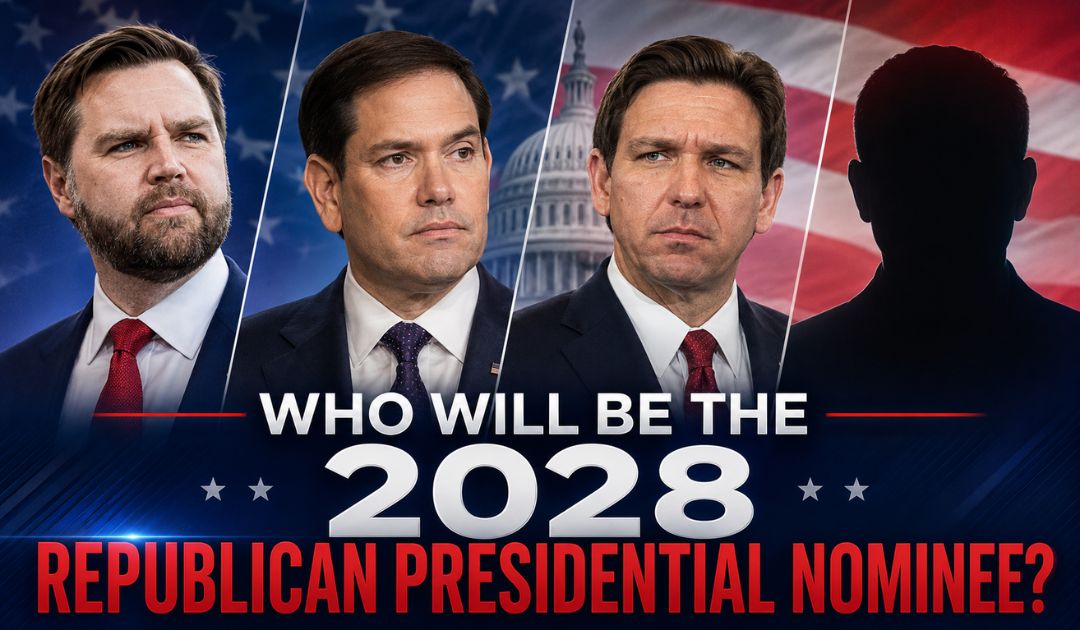
J.D. Vance currently leads both Kalshi and Polymarket in the race to become the 2028 Republican presidential nominee, but Marco Rubio remains the clear second choice as polling, straw polls, and speculation about President Trump's eventual endorsement point in different directions.
The 2028 Republican presidential primary is still more than a year away from becoming the central focus of national politics, but prediction-market traders are already putting real prices on the people they think could succeed President Donald Trump as the party's nominee.
The early picture is unusually clear at the top. J.D. Vance and Marco Rubio account for most of the serious attention on the two largest markets we're following, while the prices on Ron DeSantis, Tucker Carlson, Donald Trump Jr., and other possible contenders remain far lower.
Anyone new to event contracts can review our Prediction Markets page for an explanation of how market prices, contract payouts, and changing probabilities operate.
2028 Republican Nominee Market Snapshot
Prices and displayed probabilities are snapshots from August 25, 2026. They are market prices, not election results, polling averages, or guarantees of who will become the nominee.
J.D. Vance Leads Both Prediction Markets
Kalshi currently gives Vance a 43% chance of becoming the 2028 Republican nominee. His YES contract is trading near 44¢. Rubio follows at 23%, while every other listed candidate is below 5%.
Polymarket gives Vance an even larger 47% probability, with a current YES price near 47.4¢. Rubio is second at 20%.
Kalshi
43%J.D. Vance leads at 43%, followed by Marco Rubio at 23%.
Ron DeSantis is third at 4.9%, with Tucker Carlson at 3.6% and Donald Trump Jr. at 3%.
Polymarket
47%J.D. Vance leads at 47%, followed by Marco Rubio at 20%.
Tucker Carlson is around 3%, while Donald Trump, Ron DeSantis, and Donald Trump Jr. are around 2% each.
| Potential Nominee | Kalshi | Kalshi YES | Polymarket | Polymarket YES |
|---|---|---|---|---|
| J.D. Vance | 43% | 44¢ | 47% | 47.4¢ |
| Marco Rubio | 23% | 23¢ | 20% | 19.8¢ |
| Ron DeSantis | 4.9% | 4.9¢ | 2% | 1.9¢ |
| Tucker Carlson | 3.6% | 3.5¢ | 3% | 2.8¢ |
| Donald Trump Jr. | 3% | 3.8¢ | 2% | 1.7¢ |
| Donald Trump | 2.5% | 2.4¢ | 2% | 2.2¢ |
| Ivanka Trump | 1.2% | 1.2¢ | 1% | 0.8¢ |
| Ted Cruz | 1.2% | 1.2¢ | 1% | 1¢ |
Market prices can move at any time. A price of 44¢ does not mean a candidate has received 44% of Republican votes. It reflects the current price traders are assigning to that outcome.
Prediction Markets and Straw Polls Are Telling Different Stories
The biggest difference in the current 2028 discussion is that Vance clearly leads both Kalshi and Polymarket, while some individual Republican straw polls have produced very different results.
A Western Conservative Summit straw poll reported by The Hill gave Rubio 57% among more than 500 attendees, compared with 21% for Vance. That is a 36-point Rubio lead, but it represents attendees at one conservative gathering rather than Republican voters nationwide.
What Current Political Coverage Says About Vance and Rubio
The national political coverage is more complicated than simply declaring one candidate ahead.
The Washington Post
The Post identifies Vance and Rubio as the two standouts in the early Republican field. Its analysis describes Vance as the obvious heir apparent while noting that Rubio's experience, previous presidential campaign, and current administration responsibilities make him a serious alternative if he runs.
The Hill
The Western Conservative Summit straw poll produced a major Rubio result. Rubio received 57%, compared with 21% for Vance, among more than 500 attendees. It is an informal straw poll rather than a national Republican primary poll.
The Jerusalem Post
The supplied Jerusalem Post article covers an Emerson College poll testing Vance and Rubio against possible Democratic nominees. Rubio performed better than Vance in several of those hypothetical general-election contests. That poll is measuring potential November 2028 contests, not who Republican primary voters currently prefer.
Fox News
A Fox News opinion column describes Vance as the current frontrunner but argues that the nomination should not be considered automatic. It also identifies Rubio, Ron DeSantis, Glenn Youngkin, and other Republicans as possible participants in what could become a crowded primary.
New York Post
The Post reported that Trump publicly said it was "way too early" to endorse Vance after reports that he had privately encouraged donors to support the vice president. Trump has praised both Vance and Rubio and has also discussed the possibility of the two appearing together on a future ticket.
The 2026 Midterms Could Change the Market
One reason the 2028 prices deserve to be treated as an early snapshot is that the Republican presidential campaign has not really started.
Vance has said he will consider his political future after the November midterms, while Rubio has indicated that he would support Vance rather than challenge him if the vice president enters the race.
The Washington Post also notes that Republican insiders are watching the midterms closely. A favorable result for the administration could reinforce Vance's position, while a poor Republican performance could change how party officials and voters view the eventual field.
That makes November 2026 an obvious dividing line. Before then, most of what we're seeing consists of early positioning, individual polls, media speculation, and Kalshi Prediction Markets prices that can react immediately when new information appears.
What a J.D. Vance YES Prediction Could Look Like at 44¢
Kalshi currently shows the J.D. Vance YES contract near 44¢. At that price, each winning contract would settle at $1 if Vance becomes the Republican nominee under the market's resolution rules.
| Investment | Contracts | Approx. Cost | Winning Payout | Potential Profit |
|---|---|---|---|---|
| $25 | 56 | $24.64 | $56 | $31.36 |
| $50 | 113 | $49.72 | $113 | $63.28 |
| $100 | 227 | $99.88 | $227 | $127.12 |
| $250 | 568 | $249.92 | $568 | $318.08 |
| $500 | 1,136 | $499.84 | $1,136 | $636.16 |
| $1,000 | 2,272 | $999.68 | $2,272 | $1,272.32 |
These are simplified examples assuming contracts can be purchased at exactly 44¢. They do not include fees, price movement, or order-book slippage. Actual execution prices can differ.
The live Kalshi order example in our screenshot shows 1,000 Vance shares with an estimated cost of $457.25, a maximum payout of $1,000, and displayed potential profit of $542.75 if the YES contract ultimately resolves in the trader's favor.
Kalshi 2028 Republican Nominee Market
Kalshi's market currently has more than $60 million in reported volume and puts Vance well ahead of Rubio. The gap is sizable, but a 43% probability is still nowhere near certainty.
Readers can review the current new-user offer on our Kalshi Promo Codes page.
Polymarket Shows an Even Larger Vance Lead
Polymarket currently puts Vance near 47%, compared with roughly 20% for Rubio. The market has reported volume above $691 million, making it another substantial real-time measure of how traders are pricing the still-distant Republican nomination.
There are small differences between the two companies. Vance is several points higher on Polymarket, while Rubio is slightly higher on Kalshi. Those differences can come from separate order books, liquidity, and trading activity.
More information on the U.S. product is available on our Polymarket Prediction Markets page.


My Current 2028 Republican Prediction
As it stands today, I think it's still too early to say who will definitely become the Republican nominee. In my view, that's also what makes this stage of the market interesting. Once the 2026 midterms are over, I expect the political conversation to shift heavily toward 2028, and these prices could look very different.
If J.D. Vance announces that he's running, I think he would quickly consolidate a large share of the Trump-aligned Republican base. If that happens, I would expect his contract price to rise and a lot of the smaller names on these markets to fall sharply.
If Vance decides not to run and Marco Rubio does, I could see a similar situation developing around Rubio. Both are already at the center of the Republican succession discussion, and the prediction markets reflect that by putting a huge gap between Vance and Rubio and almost everybody else.
Personally, my current prediction is still a Vance-Rubio ticket in 2028 unless something changes the race substantially. Trump has already spoken positively about the idea of the two running together, and Rubio has said he would support Vance if Vance decides to run.
When Trump recently said it was "way too early" to endorse Vance, I didn't hear that as Trump rejecting him. My interpretation was closer to: first deal with the 2026 midterms, then start talking seriously about 2028. That's only my interpretation of his comments, not a statement about what Trump actually intends to do.
The biggest question for me is what happens after November. Do Vance and Rubio remain aligned, does one step aside for the other, or does somebody else emerge and completely change the field? What do you think?
Why It's Still Too Early to Call the Republican Nomination
Neither the Kalshi lead nor the Polymarket lead guarantees that Vance will become the nominee. The election is still far away, the candidate field is unsettled, and even Trump's eventual role in the nomination fight remains uncertain.
The Western Conservative Summit result is also a reminder that individual Republican audiences can produce very different preferences from national prediction markets. Rubio winning that particular straw poll by 36 points and Vance simultaneously leading hundreds of millions of dollars in prediction-market activity are not mutually exclusive. They are measuring different groups in different ways.
The same applies to general-election polling. Rubio performing better than Vance against several hypothetical Democrats in one Emerson survey does not automatically mean Rubio would defeat Vance in a Republican primary.
For anyone following this race through Polymarket Promo Codes or other prediction-market pages, the distinction matters. A prediction-market price is a current market estimate, not a scientific opinion poll.
What Could Move These Prices Next?
The biggest near-term event is the November 2026 midterm election. After that, candidate announcements, Trump's public position, new national and state polling, campaign organization, fundraising, endorsements, and debates could all move the 2028 nominee markets.
At this stage, Vance has the prediction-market lead, Rubio is the clear alternative, and everyone else is priced far behind them.
Sources
- The Washington Post: Sizing Up the 2028 Republican Presidential Contenders
- The Jerusalem Post: Rubio Holds Advantage Over Vance in Matchups Against Democratic Presidential Candidates
- The Hill: Rubio Leads Vance by 36 Points in 2028 GOP Straw Poll
- Fox News: The GOP's Choice in 2028
- New York Post: Trump Says It's Way Too Early to Endorse J.D. Vance

Robert Beadle
Robert Beadle leads Bonus Predictions editorial direction, research, and digital publishing. His coverage includes prediction markets, event contracts, political markets, current promotions, and the news and data affecting contract prices.
Bonus Predictions may receive compensation when readers create an account or complete qualifying activity through affiliate links on this page. Prediction-market prices can change at any time and are not election results or guarantees. The Author Opinion section reflects the author's personal view and is separate from the reported market data and third-party reporting. Review each company's current eligibility requirements, promotion terms, fees, market rules, and maximum possible loss before trading.
Join the Discussion
Leave a Comment on This Story